Managing a Contractor: Change Orders & Scope Creep
The most expensive conversation in a renovation rarely happens before the first hammer swings. It happens three weeks in, when the plumber opens a wall and says the quote is about to change. Here's how to handle that conversation — and the ones like it — without the relationship imploding.
There’s a specific phase of every renovation that nobody warns you about. It’s not the planning stage or the demo — it’s the moment when the contractor opens a wall, looks at something you couldn’t possibly have known was there, and says the words that make every homeowner’s blood run cold: “we’ve found something that wasn’t in the quote.”
Or worse: “while you’re here, can you also…” — the polite, almost accidental invitation that turns a three-week project into a six-month one.
Managing a contractor well isn’t about micromanaging or standing over them with a stopwatch. It’s about setting up the system so that surprises don’t become financial surprises, and so that the relationship stays professional when things inevitably go off-script.
Here’s what that looks like in practice.
The written scope is your first line of defence
The single most important document in a renovation isn’t a budget spreadsheet or a mood board. It’s the written scope of work — a plain description, trade by trade, room by room, of what the contractor will actually do.
If it’s not in the scope, it doesn’t happen. That’s not pedantry; it’s the only thing that keeps a project from gradually morphing into something neither of you originally agreed to.
The same written scope is what makes bids comparable in the first place. The guide to comparing contractor quotes shows how to use it before you sign anything.
A good scope of work includes:
- What will be done — specific tasks, not vague intentions. “Replace kitchen floor” means something very different from “make the kitchen floor better”
- Materials specified — brands, model numbers, or at minimum a process for how materials will be selected. “Tile to homeowner’s specification” is a recipe for blame later
- What’s excluded — the things the contractor is not doing, stated explicitly. Skip this and assumptions fill the gap, usually in the wrong direction
- A payment schedule — tied to completed milestones, not arbitrary dates. Never pay more than 10% upfront for a large project
- A change-order process — a single sentence that says “any additional work will be documented in a written change order signed by both parties before work begins”
You’ve already got a template for this in how to plan a renovation step by step. The scope document is the single most concrete output of that planning phase, and it’s the one you reference every time a question comes up.
Change orders: normal, necessary, and often misunderstood
A change order is not a contractor scam. It’s a professional practice. Any skilled tradesperson who’s been working for years has seen a situation where the original plan doesn’t match the reality behind the walls. A change order is simply the formal way of documenting that mismatch.
The problem isn’t change orders — the problem is informal change orders.
When a contractor says “we’ll do that, it’ll be about two hundred extra” and you say “sure” and nobody writes anything down, you’ve created a situation where:
- You forget what was agreed and the contractor forgets too
- When the invoice lands two weeks later, you’re surprised by the amount
- The contractor feels cheated because they did the work and expected to be paid
- Both sides walk away feeling the other was dishonest, even though neither was
The solution is mechanically simple and requires zero trust:
Any change to the agreed scope gets a written note — a text, an email, a line in your renovation notes — before any extra work starts. The note says what’s changing and what it costs. The work doesn’t start until both sides agree to the note.
Two hundred words. That’s it. No forms, no lawyers, no drama. A text message saying “Just to confirm — we’re adding under-cabinet lighting at £180. Let me know if that’s wrong” is a legally defensible change order if both sides are honest.
Scope creep: the silent budget killer
Change orders for genuine surprises are manageable. Scope creep is what actually kills budgets, and most homeowners don’t notice it happening until they’re thirty percent over.
Scope creep is the slow addition of small extras, each one individually reasonable but collectively catastrophic:
- “While you’re here, can you also fix the skirting board in the hallway?”
- “The electrician’s already here — could they move that socket two inches?”
- “Since the floor’s been taken up, it would be a good time to treat it for damp too.”
- “The door doesn’t quite close right now but it could if you adjusted the frame.”
Each one costs maybe £30 to £80. On its own, nobody notices. But by week six, you’ve accumulated twelve £50 extras, and suddenly you’ve blown half your contingency on work that nobody originally budgeted for.
The antidote is a threshold:
Any unplanned addition that costs more than [your threshold — say £100] gets a written note and a yes/no decision. Anything below it, fine, do it. But you set the threshold and you stick to it.
This does two things:
- It lets the contractor do small useful things without slowing down to paper trail every one
- It forces a conscious decision on anything that matters financially
Put that threshold in writing with your contractor on day one. “Anything over £100, let me know in writing before you do it. Below that, just get on with it.” Both sides know where they stand.
Setting expectations on day one
Most contractor problems don’t arise from malice. They arise from mismatched expectations. The homeowner thinks “finished” means “moved in.” The contractor thinks “finished” means “the trades are done.” Both are right, and both are wrong.
Here’s what to agree on before a single tool touches the house:
- Working hours — when the crew arrives, when they leave, whether they work weekends. A silent assumption about “8 to 5, Monday to Friday” varies widely between trades
- Site cleanliness — do they tidy at the end of each day? How is waste disposed of? Where do they put tools and materials?
- Communication cadence — will there be a weekly walk-through? A shared notebook? Daily texts? Pick one and write it down
- Decision timelines — what happens when you don’t pick a tile by the date they need it? The best-laid schedules fall apart when decisions lag
- Who’s on site — will it be the contractor themselves or a foreman with a crew? This affects both quality and who you’re actually dealing with
- How problems get escalated — if the crew finds something unexpected, who decides first: the on-site foreman or the main contractor? Make sure there’s a clear chain
You can see how all this connects to the broader planning process in our guide to renovation phases. Understanding the sequence of trades and when decisions are needed helps you avoid the most common delays.
Keeping the relationship civil
This deserves its own section because it’s the thing that gets overlooked when everyone’s focused on the paperwork.
The best contractor relationships I’ve seen — across a dozen renovation projects — share three traits:
1. Homeowners pay on time. There is nothing more effective at making a contractor want to do good work than being paid promptly, without having to chase. Set up standing orders if you need to.
2. Homeowners don’t change their mind constantly. Every mid-project pivot costs time and money. Make your decisions early. If you’re unsure about a finish, decide during the planning phase, not three weeks into installation.
3. Contractors are treated as professionals. Not employees, not servants, not the enemy. The person you’ve hired to do a skilled job. A simple “thanks for the update” after a site visit costs nothing and builds real goodwill.
Conversely, the relationships that end badly usually involve one (or more) of:
- The homeowner calling the contractor every day to ask what’s happening
- The homeowner bringing their neighbour’s husband to “advise” the trades on site
- The contractor going silent for three days without explanation
- Both sides communicating only through the grapevine (the spouse tells the homeowner’s partner, who tells the homeowner, who confronts the contractor)
Most of these can be prevented with one meeting and thirty minutes of shared paper.
Your contingency budget is here for this
Earlier, we looked at how to size a contingency budget — and the answer is that anything other than a surface-level refresh needs 15–20% reserved for the things nobody sees coming.
Managing contractors well is partly about using that contingency judiciously. Legitimate change orders — hidden pipes, structural surprises, code requirements that weren’t known — should come from contingency, not from the decorative budget. Scope creep should come from nowhere, because it’s been filtered at the threshold before it reaches that point.
The people who finish renovations with their sanity mostly intact tend to be the ones who budgeted for friction, not just for tiles.
One system, one place
All of this — scopes, change orders, daily notes, photo documentation of work as it progresses, receipts for extra materials — works best when it lives in one place instead of across three notebooks, a shoebox of thermal receipts, and whatever’s on your phone home screen.
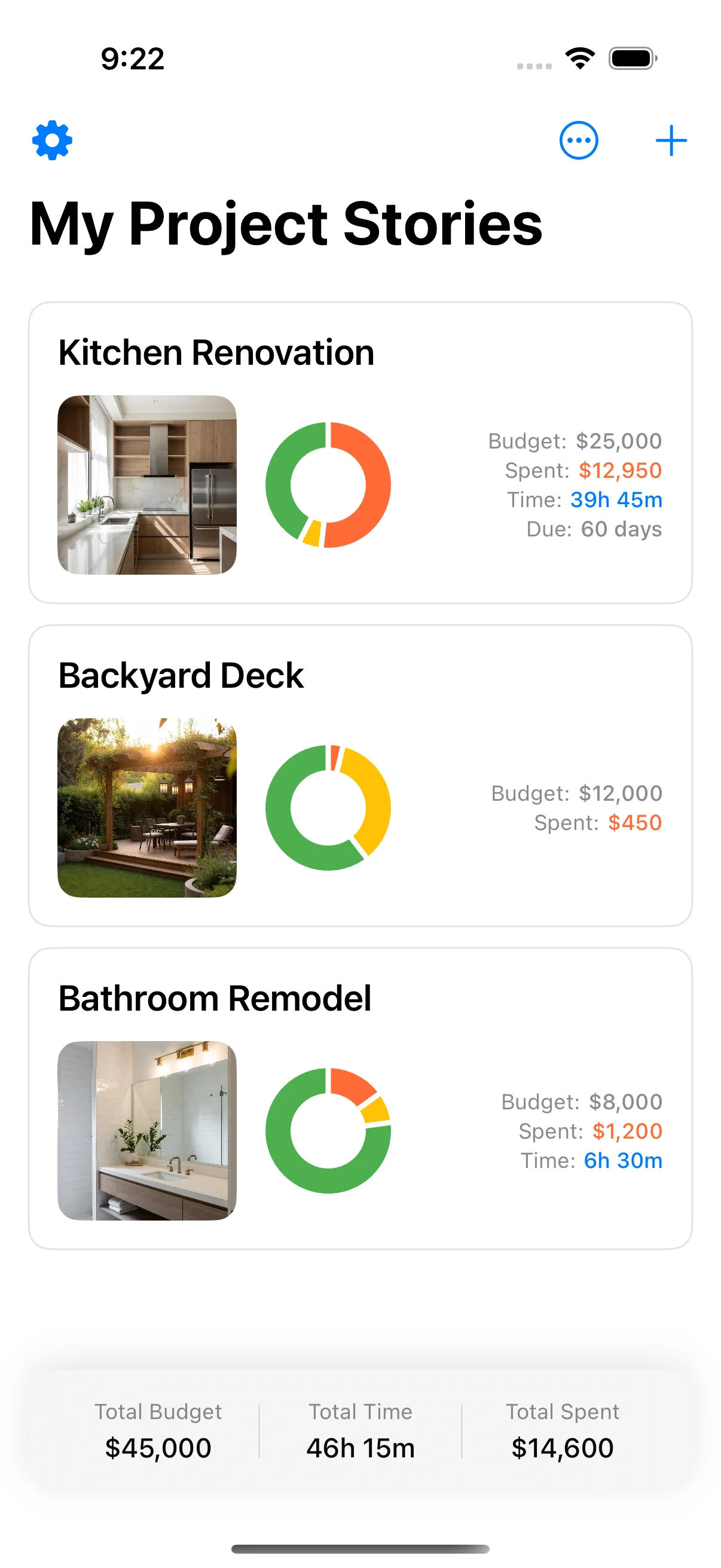
Home Stories is a free app for iPhone and iPad built specifically for this kind of thing. It keeps your budget, your change-order notes, your before-and-after photos, and your receipt scans all attached to the same project. A PDF of the project, if you need to share it with a partner, accountant, or insurance company, is part of Pro. But the principle matters more than the tool — whatever system you choose, make it centralised, date-stamped, and hard to lose.
Wrapping up
Change orders mostly appear when you hire; if you are still deciding what to keep in-house, read DIY vs hire a contractor first.
Managing a contractor isn’t about control. It’s about clarity.
Get the scope in writing. Require a written note before any extra work. Set a threshold for scope creep. Pay on time. Communicate clearly. And keep everything documented in one place.
Do that, and the three-week project stays three weeks. Skip it, and the kitchen refit becomes a year-long negotiation about work nobody originally agreed to.
The choice, as usual, is yours.
Sources and further reading
The ranges and guidance above are drawn from direct project experience and from the bodies below, which publish the underlying standards, rules and market data. They are worth reading directly before you commit money.
- How To Avoid a Home Improvement Scam — US Federal Trade Commission
- Finding and vetting a builder — Federation of Master Builders (UK)
- Home improvements and repairs — US Dept. of Housing and Urban Development
Frequently asked questions
What is a change order?
A change order is a written document — just a few lines is enough — that records what work has changed, why it changed, and how much the change costs. It gets signed by both sides before the new work starts. A professional contractor expects to issue them; it's how they protect themselves too.
How do I stop a contractor from charging for unexpected extras?
You can't stop legitimate extras — walls hide things you can't see until they open — but you can stop surprises from becoming price shocks. The key is a detailed written scope up front and a simple rule: no extra work happens without a written note and a price agreed first. If the contractor can't give you a written change order for a modification, that's a red flag about the relationship.
What is scope creep and how do I prevent it?
Scope creep is the slow accumulation of small additions — 'while you're here, can you also…' — that nobody writes down. It happens naturally in renovations because you're living in a space that's slowly revealing its problems. Prevent it by setting a simple boundary: any addition that costs more than a threshold you choose (say, $200) gets a written change order before it starts.
Can I just leave a contractor in charge and not micromanage?
You can, and for some projects that's the right call — especially if you're paying a fixed price for a defined scope. But if your project is priced hourly or you've given the contractor discretion over materials and sequence, then some level of management is unavoidable. The trick isn't micromanaging or handing off completely; it's setting clear rules for decisions and changes upfront.
How do I keep a good relationship with my contractor?
Treat them like professionals doing a skilled job — which they are. Be clear about what you want, pay on time, don't change your mind constantly mid-project, and communicate in writing when it matters. The contractors who survive multiple renovations with their sanity intact tend to share one trait: they chose the right contractor, and they knew what to expect.
Should I document conversations with my contractor?
Yes. A quick text or email summarizing what you just discussed — 'Just to confirm, we agreed on X at £Y, and the original scope stays the same for the remaining work' — costs nothing and prevents a world of disagreement later. If you're already tracking notes in a renovation tool like Home Stories, just add the conversation there with a date.
What should a scope of work include?
At minimum: a room-by-room or trade-by-trade breakdown of what will be done, materials specified (brands, model numbers, or at least 'to be selected by homeowner'), exclusions (what the contractor is NOT responsible for), a payment schedule tied to completed milestones, and a clause describing how changes will be handled.
Keep reading

How to Budget a Home Renovation: 7 Steps to an Honest Budget
How to budget a home renovation — 7 steps to build an honest budget that covers scope, contingency, and every hidden cost.

How to Plan a Home Renovation: 6 Phases from Idea to Handover
How to plan a home renovation — 6 phases from inspiration to handover, with what to track and watch for at each stage.

Renovation Contingency Budget: How Much to Set Aside and Why
Renovation contingency budget — why you need 15-20% extra, where surprises come from, and how to track your contingency.