DIY vs. Contractor: The Five-Minute Test That Saves You Money
Every renovator eventually reaches the same fork: do I tackle this myself, or call in a professional? The answer isn't about skill level or pride. It's about a few practical questions most people never think to ask before they've already bought the materials.
Every renovator hits the same fork at some point. You’re standing in a room — maybe it’s a kitchen that’s been “almost done” for eighteen months, maybe it’s a bathroom you just bought a tub for — and the question presents itself: do I tackle this myself, or call someone in?
The honest answer is almost never the one you expected.
Most people arrive at this decision through a mix of pride (“I watched a YouTube video, how hard can it be?”) and budget anxiety (“I really can’t afford another $4,000 right now”). Neither is a bad starting point. But neither is a reliable decision tool.
After more renovation projects than I care to count — some of them very public failures — I’ve settled on a simple framework. It takes about five minutes to run through. And once you do, the right choice tends to be obvious.
The four questions
1. What happens if I mess up?
This is the most important question and the one most people skip. It’s not about whether you’re capable of doing the work. It’s about the cost of getting it wrong.
If you’re painting a room and you miss a spot, the worst that happens is you repaint. If you’re moving a load-bearing wall and you get it wrong, you’re looking at engineering reports, permits, and a bill that could be ten times the original quote.
The test: Name the worst realistic outcome of a DIY mistake on this project. If that outcome costs more than the contractor’s quote, you already know what the decision should be.
2. What is the total hidden scope?
This is where DIY projects usually go off the rails. You find yourself watching a ten-minute video on “how to install tile,” and it looks straightforward. The video doesn’t mention that you also need to:
- Check whether the subfloor is flat enough (it almost never is)
- Buy thinset, spacers, grout, a wet saw rental, and a level that’s actually level
- Deal with the fact that your walls aren’t plumb and half your tiles will need to be cut to weird angles
- Figure out how to work around the plumbing fixture that’s now two centimeters off from the template
This isn’t a rant against DIY. It’s about scope. Every project has hidden steps that nobody films a video about because they’re obvious to people who do this for a living. But they’re not obvious to you, and they’re not free.

The test: Write down every step the project requires — including the prep, the cleanup, and the tools you’d need. Then compare that list to what you’ve actually planned for. The gap is usually where the budget and the timeline both die.
3. How many hours will this really take?
The most honest mistake homeowners make is not about skill or consequence. It’s about time. You budget for the visible work — six hours to install shelving, a Saturday to build a deck. You don’t budget for:
- The two hours spent researching which type of screw goes into what kind of wall
- The trip to the hardware store because you forgot grout
- The Sunday evening you spend scrubbing dried adhesive off the floor
- The phone call to the supplier because the wrong depth of recessed lighting was shipped
The test: Track your hours like a contractor would. Every hour counts — research, shopping, work, cleanup, phone calls. Log them in a project notebook or an app. After a few weekends, look at the total. Then multiply by what your time is actually worth to you. You’ll often find that the DIY route is more expensive than you thought.
This is the part nobody wants to hear because it makes DIY sound expensive. But “free” DIY is only free if you’re willing to give the hours away without charging yourself. The moment you put a dollar figure on your own time — even a modest one — the cost comparison usually tilts toward hiring someone who does this every day.
4. Can you see the finished result in your head?
This sounds abstract, but it’s the most practical question there is. A good indicator of whether a project belongs in the DIY pile is whether you can picture the final result clearly enough to describe it to someone else.
If you know the exact paint code, the type of wood, the dimensions, and the sequence of steps — you’re in DIY territory. You can follow a recipe when you can see the cake.
If you’re only partway through the planning stage — you know you want “a kitchen that feels bigger” but you haven’t figured out whether that means refacing cabinets, painting them white, or replacing them entirely — then you need more guidance than YouTube can provide. And that guidance comes from a professional who has done this thirty times.
Where DIY usually works and where it doesn’t
Some projects genuinely belong in the DIY pile. Painting, demolition, assembling pre-made items, outdoor cosmetic work — these have low consequence and clear scope. You can see the finished result in your head, the tools are cheap, and mistakes are usually fixable.
Other projects tend to belong to professionals: anything touching plumbing, electrical, or gas; structural changes; anything that can’t be undone (tile, concrete, custom cabinetry); projects requiring specialized tools you’ll only use once; anything with a hard deadline.
The hybrid approach
Here’s the thing most people don’t tell you: you can mix both. Many homeowners do the prep work themselves — demo, painting, clearing out old fixtures — and then hire a pro for the skilled portion. Or they DIY the non-critical elements and hire for the things that actually matter structurally.
The key is deciding up front where the line is. Don’t start a project thinking you’ll DIY and then call a contractor halfway through because you hit something you didn’t expect. That “change order” mindset is exactly what makes renovation costs spiral, and a contingency budget is what absorbs it when it happens anyway. If you know part of it will be pro work, plan the scope with that in mind from day one — the phases of a renovation are a useful frame for deciding where the handover points sit.
The honest decision matrix
Here’s the framework I keep going back to, compressed into something you can run through in five minutes:
- Write the contractor quote (even if it’s just a rough range from three phone calls).
- List every step the DIY version would require, including tools and materials.
- Track your hours honestly for one weekend — every minute, including research and shopping.
- Multiply your hours by what they’re worth to you.
- Compare the numbers and ask: “Would I save money hiring someone, and what would I be giving up?”
If the answer is “I’d save money DIYing,” go for it. If the answer is “hiring is cheaper when I count everything,” hire. And if the answer is “I don’t know” — that’s the most common outcome — then lean toward hiring, because the uncertainty itself is a cost you haven’t factored in.
Step 1 is easier if you already know roughly how long the job runs when a professional does it: how long it takes to install flooring is a good example of a job where the material, not the labour, sets the schedule — and where a DIYer’s timeline and a pro’s are much closer than for something like rewiring a house.
The tool that makes this honest
The hardest part of this framework is that step about tracking your hours honestly. Most people don’t — because there’s no reason to, until you’re sitting there with a contractor’s quote and wondering if you should have called sooner.
I started doing this after a particularly embarrassing weekend when I logged 18 hours of “DIY” kitchen prep and it turned out the contractor’s quote was $600 less than what I’d spent on tools and wasted materials. That was the moment I realized: the real comparison isn’t between DIY and hiring. It’s between an honest budget and a hopeful one.
You don’t need any app to make this decision. A notebook and a calculator work. But if you’re going to track hours honestly, why not make it as easy as opening the app you already use every day?
The bottom line
The DIY or contractor decision is rarely about skill. It’s about three things:
- Consequence — what happens if you get it wrong?
- Scope — how many hidden steps are there that nobody mentions until you’re in the middle of them?
- Time — what are your hours actually worth, when you count every minute?

Run through those four questions. If the numbers surprise you (and they probably will), you’ve saved yourself a lot of potential pain. And if the answer is still “I think I can handle this” — well, nobody’s stopping you. Just know exactly what you’re signing up for.
Loft conversions are rarely weekend DIY — how long a loft conversion takes shows why the calendar is mostly waiting on structure and inspections.
Once you decide to hire, how to compare contractor quotes stops you picking on headline price alone.
Extensions are almost always hire territory — how long a house extension takes shows where the calendar actually goes.
Most homeowners hire window crews; how long window replacement takes is mostly manufacturing and making-good, not the fit day.
Sources and further reading
The ranges and guidance above are drawn from direct project experience and from the bodies below, which publish the underlying standards, rules and market data. They are worth reading directly before you commit money.
- How To Avoid a Home Improvement Scam — US Federal Trade Commission
- Finding and vetting a builder — Federation of Master Builders (UK)
- Renovation, Repair and Painting (RRP) rule — lead-safe work — US Environmental Protection Agency
Frequently asked questions
How do I know if I'm good enough to DIY a project?
Ask two questions instead: 'What happens if I mess this up?' and 'What does it cost to fix my mistakes?' If the answer to either is 'a lot,' that's your signal to hire someone. Skill is rarely the deciding factor — consequence is.
When does it make financial sense to hire a contractor?
When the contractor's quote is less than your hours multiplied by what those hours are worth to you — factoring in tool costs, material waste from mistakes, and the time it takes to learn something you'd only do once. A $3,000 quote is cheaper than 80 hours of your evenings plus a $400 drill you'll only use three times.
Can I DIY part of a project and hire a pro for the rest?
Absolutely. Many people demo and prep themselves and hire for the skilled trades (plumbing, electrical, tiling). The key is deciding up front which part is which, and making sure both sides know exactly where their responsibility begins and ends.
How long does a typical home renovation project take?
Plan for considerably longer than you think. A two-week kitchen remodel often stretches to six or more. A weekend deck project frequently becomes a month-long affair. The gap comes from material delays, unexpected conditions behind walls, and the fact that every trade takes days between booking and showing up.
What should I ask before hiring a contractor?
At minimum: Can you give me a written quote that breaks down labor and materials? What's included and what's not? How do you handle changes once the work starts? And can you show me two similar projects you've finished? If they won't put it in writing or won't share references, keep looking.
Should I track my DIY time the same way contractors do?
Yes. Most homeowners count hours spent but don't count time spent at the store, on research, on cleanup, or on the phone with suppliers. If you log everything the way a professional would, you'll see that what you thought was a 'free' afternoon project usually runs well over 20 hours — and that changes the cost comparison.
Where can I keep track of a renovation project while deciding between DIY and pro work?
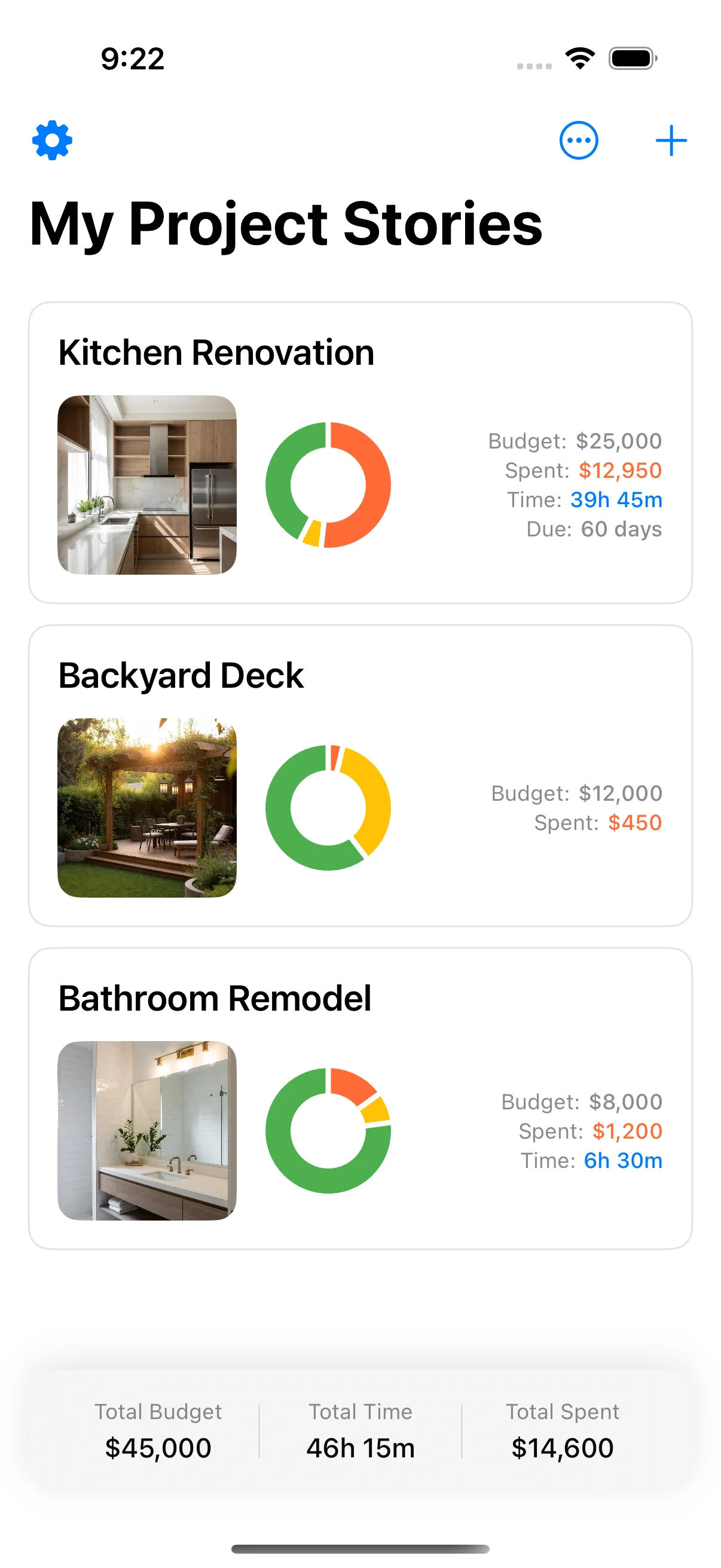
One project, one place — somewhere you can log quotes, track time, take photos of the work, and see your budget all in one view. Home Stories is built for this: it keeps budget, time tracking, receipts, and photos attached to each project so you can compare DIY hours against contractor quotes without juggling five different tools.
Keep reading

How to Budget a Home Renovation: 7 Steps to an Honest Budget
How to budget a home renovation — 7 steps to build an honest budget that covers scope, contingency, and every hidden cost.
How to Plan a Home Renovation: 6 Phases from Idea to Handover
How to plan a home renovation — 6 phases from inspiration to handover, with what to track and watch for at each stage.
Renovation Checklist Printable: Your Complete Step-by-Step Guide
Renovation checklist printable — a complete step-by-step renovation checklist you can use to plan and track every phase.