11 Things I Wish I'd Tracked Before Starting My Renovation
Ask anyone who's finished a renovation what they'd do differently and you rarely hear about tile choices. You hear about information: the photo they didn't take, the receipt they can't find, the verbal quote that grew 40% between the handshake and the invoice. This is the list I'd hand my past self on day one.
There’s a specific kind of regret that only shows up months after a renovation ends. It isn’t about the work — the work is usually fine. It’s about the record of the work: the thing you didn’t photograph, the number you didn’t write down, the conversation that lives only in two people’s increasingly different memories.
None of these take skill to avoid. Every one of them takes less than a minute in the moment. If you are searching for what to track during a renovation, start here — eleven habits that cover almost every regret I have heard from people who finished a project and then needed a number, a photo, or a date they no longer had.
None of these take skill to avoid. Every one of them takes less than a minute in the moment. Here are the eleven that come up again and again — from my own projects and from every renovator I’ve compared notes with.
1. Every wall, before it closed
The single most valuable photo in a renovation is the one of an open wall. Cables, pipes, junction boxes, the place the old chimney was — all of it disappears behind plasterboard, and from that day forward every question about it costs money to answer.
Photograph every open wall, floor, and ceiling the day before the plasterer or screed crew arrives. Wide shots for context, close-ups at anything that carries water or current. Make sure they’re dated. You will not remember which week the bathroom wall closed; the photo’s timestamp will.
2. Receipts, at the till
Not in a shoebox at the end of the month. At the till, while the paper is still in your hand — thermal receipts fade, and the eighth trip to the hardware store erases the seventh from memory. A photographed receipt with a date and a project attached is evidence: for the tax deduction when you sell, for the insurance claim (the full documentation trail an insurance claim needs is worth reading before you need it), for the warranty argument. We wrote a whole photo-first receipt system about this, because it’s the habit with the highest money-recovered-per-second ratio.
3. The quote next to the invoice
A quote is a promise; an invoice is what happened. Kept apart, they never get compared, and the gap between them — the extras, the “while we were in there”, the hours that grew — is exactly where budgets die quietly.
Keep every quote, and when the invoice lands, put the two numbers side by side while you can still remember what changed. Sometimes the gap is fair. You want to know, either way.
4. Money you’ve committed but not paid
The kitchen is ordered. The electrician is booked. Nothing has left your account, and your spreadsheet says you’re fine. You are not fine — that money is spoken for.
This is the single most common way renovators end up “suddenly” over budget: money you have already agreed to spend never made it into the total. The moment you sign anything, it belongs in the running total. Watching that total against the budget is the whole trick to not going over.
5. The small stuff
For the money side in more depth — spreadsheets versus apps versus notebooks — see how to track home improvement expenses.
Nobody’s budget is killed by the kitchen. It’s killed by screws, silicone, another brush, two more meters of cable, the parking, the skip that needed emptying twice. Individually invisible, collectively a four-figure line item that appears in no plan.
Log the small purchases with the same reflex as the big ones. If logging one takes more than ten seconds, your system is too heavy — that’s a tooling problem, not a discipline problem.
6. Your hours
DIY isn’t free; it costs evenings and weekends. Track the hours anyway — not to be grim about it, but because the number makes two decisions honest. First: whether the next job is really cheaper done yourself. Second: whether the timeline slipping is a mystery or just arithmetic.
7. Decisions, and the why
Paint code, tile batch, the model number of the mixer tap, which wall you decided not to move and why. Six months later, when a tile cracks or you’re matching paint for touch-ups, the decision matters and the reasoning has evaporated.
One note per decision. What, when, why, and where it was bought. It reads like bureaucracy until the day it reads like genius.
8. The order of the trades
Electrician before plasterer. Floor before kitchen. Painter last, always, no matter what the painter says about being flexible. The sequence is the plan — and when a date moves, everything downstream moves with it.
Write the sequence down as tasks in phases, not as a feeling. It’s the difference between rescheduling a chain and rediscovering it. The phases guide covers the standard order and what belongs in each.
9. What was actually said
“He said the extra socket was included.” “She said week 14 was realistic.” Verbal agreements run renovations — and memory is the worst possible storage medium for money-shaped promises.
After every meaningful conversation with a contractor, one line in the project notes: date, who, what was agreed. Not because anyone is dishonest — because everyone is human, and a dated note settles in ten seconds what an argument can’t settle in an hour.
10. The contingency burn
A contingency isn’t a lump; it’s a fuel gauge. If you set aside 15% and you’ve burned 10% of it while the project is 30% done, that’s not a footnote — that’s the earliest, cheapest warning you will ever get.
Check the gauge at every phase boundary. Spent contingency never comes back; pretending otherwise is how “we were fine until suddenly we weren’t” happens.
11. What “done” means
The last 5% of a renovation is a fog of almosts: the door that doesn’t quite close, the missing skirting corner, the socket cover in a drawer somewhere. Without a written definition of done — a snag list, room by room — the fog becomes the permanent state of the house.
Write the list before the final walkthrough, walk it with the contractor, and date every item as it clears. The project ends when the list is empty, not when everyone is tired.
How do these eleven fit a normal week?
A useful way to think about what to track during a renovation is by when the capture happens, not by category alone.
At the merchant or on site (seconds): receipts, small purchases, open-wall photos, a one-line note after a contractor conversation. If it does not happen in the moment, it usually does not happen.
At the kitchen table that evening (minutes): quote-versus-invoice comparisons, updating committed money when you signed something, checking contingency burn against how far along the phase is.
At phase boundaries (a short review): trade sequence, whether “done” for this room still matches the snag list, and whether decisions you made last month still hold when a finish arrives looking different from the sample.
Worked example — illustrative numbers only. Say your contingency is $8,000 on a $40,000 project. By the end of demolition you have spent $2,400 of contingency on asbestos sampling and a surprise waste load. The project is roughly 15% done by calendar, but you have already used 30% of the contingency buffer ($2,400 ÷ $8,000). That is not a crisis yet; it is a signal to pause before the next change order. If you only look at “money left in the bank” you might feel fine. If you track contingency burn against phase progress, you see the mismatch early enough to cut scope or renegotiate.
That same discipline shows up when quotes drift. Keep the original quote next to the invoice, and when extras appear, treat them like the change-order process — written, dated, approved — not like a shrug at the final walkthrough. If you are still gathering bids, how to compare contractor quotes is the upstream habit that makes item 3 (quote next to invoice) possible later.
A lightweight weekly review
Once a week, for fifteen minutes:
- Open the project record and check the running total against the budget.
- Scroll photos from the last seven days — any open wall that closed without a shot?
- Skim notes for verbal agreements that never became a written line.
- Update the snag list for rooms that are “almost done”.
- Glance at contingency burn versus phase progress.
If that review takes longer than fifteen minutes, your system is too heavy. The point of tracking during a renovation is not a perfect archive on day one — it is a habit light enough that you still do it in week twelve.
Every one of these eleven is a seconds-long habit in the moment and a genuine loss when skipped. The pattern behind them all: a renovation generates evidence continuously, and the evidence has to be caught live or reconstructed painfully.
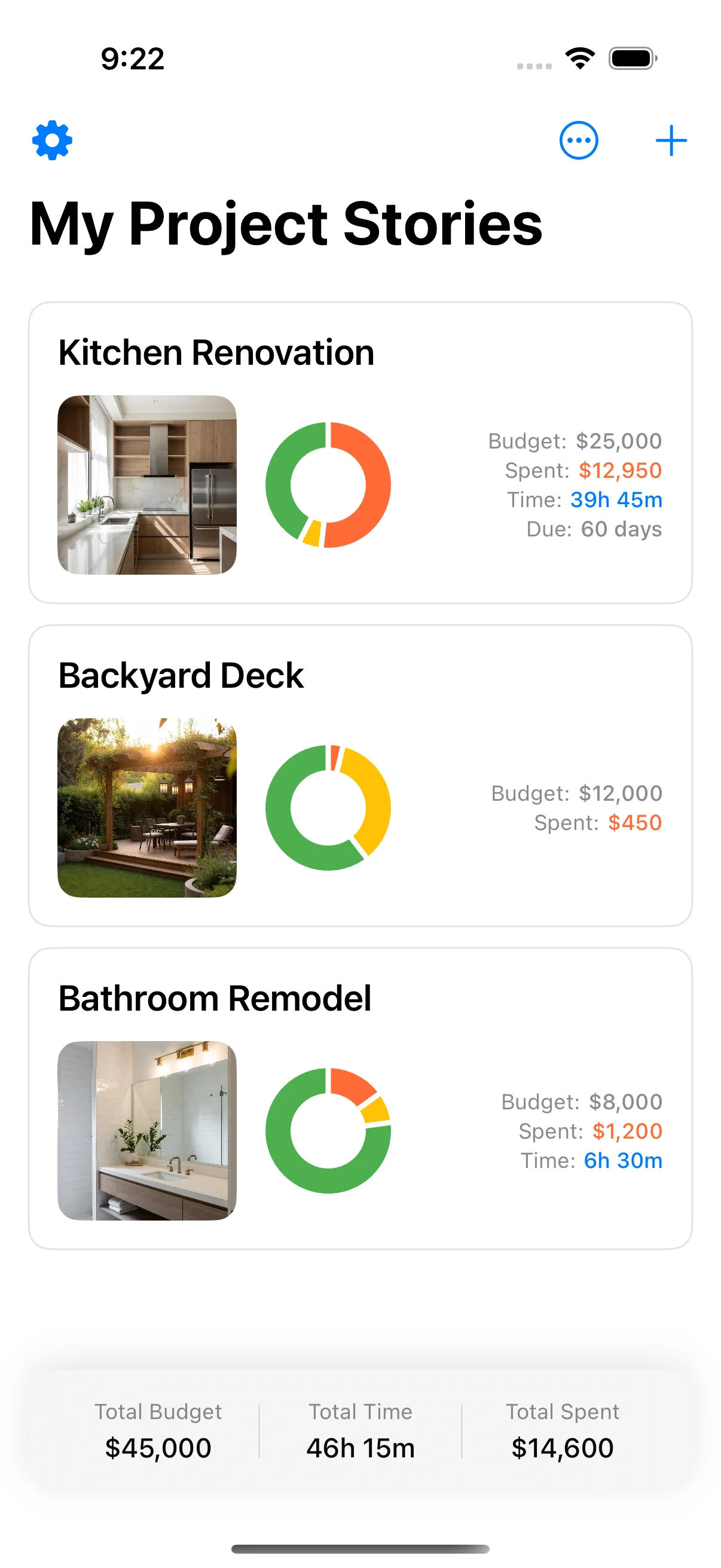
You can run all eleven habits with a phone camera, a notes app, and heroic discipline. Or you can keep them in one place, attached to the project, with the totals doing themselves. Home Stories is free, built for exactly this list, and lives in the pocket you already bring to the job site.
Start it before the first wall opens. Your future self — standing in a finished kitchen, holding a drill, wondering what’s behind that plasterboard — is counting on you.
Sources and further reading
Consumer-protection and insurance documentation guidance worth reading before you need it mid-project.
- Facts + statistics: homeowners and renters insurance — Insurance Information Institute
- How To Avoid a Home Improvement Scam — US Federal Trade Commission
- Home improvements and repairs — US Dept. of Housing and Urban Development
Frequently asked questions
What should I track during a home renovation?
At minimum: dated photos of every wall and floor before they're closed up, every receipt and invoice, each quote against its final bill, money you've committed but not yet paid, hours spent, and the decisions you made — paint codes, model numbers, and why. Everything else on the list of eleven is a refinement of those.
Why do I need photos of walls before they're closed?
Because everything important ends up behind plaster: cables, pipes, junctions, insulation. When you drill a shelf next year — or when a plumber quotes you for exploratory demolition — a dated photo of the open wall answers in seconds what would otherwise cost real money to find out.
How do I track renovation costs I've agreed to but not paid yet?
Treat 'committed' as its own category, separate from 'spent'. A signed quote, an ordered kitchen, a booked electrician — that money is gone in every practical sense, it just hasn't left the account. Budgets blow up when committed costs stay invisible until the invoices land.
Is it worth tracking DIY hours on a renovation?
Yes, for two reasons. It makes the DIY-versus-contractor decision honest — 40 hours of your evenings is not free. And if you ever sell, a record of the work done, when, and by whom is part of the story of the house.
What's the easiest way to keep all of this in one place?
One project, one tool, on the device that's already in your pocket. Home Stories keeps budget, photos, tasks, receipts, time, and notes attached to the project itself. A full data export is included. A PDF, when someone official asks, is part of Pro.
Keep reading

How to Compare Contractor Quotes (and Spot the Sign-Today Discount)
How to compare contractor quotes line by line — put every bid on the same scope, find what's missing, and see through the sign-today discount.

How to Organize Renovation Receipts: A Photo-First System
How to organize renovation receipts — a photo-first system that keeps every receipt, invoice, and contract in one place.
How to Plan a Home Renovation: 6 Phases from Idea to Handover
How to plan a home renovation — 6 phases from inspiration to handover, with what to track and watch for at each stage.